
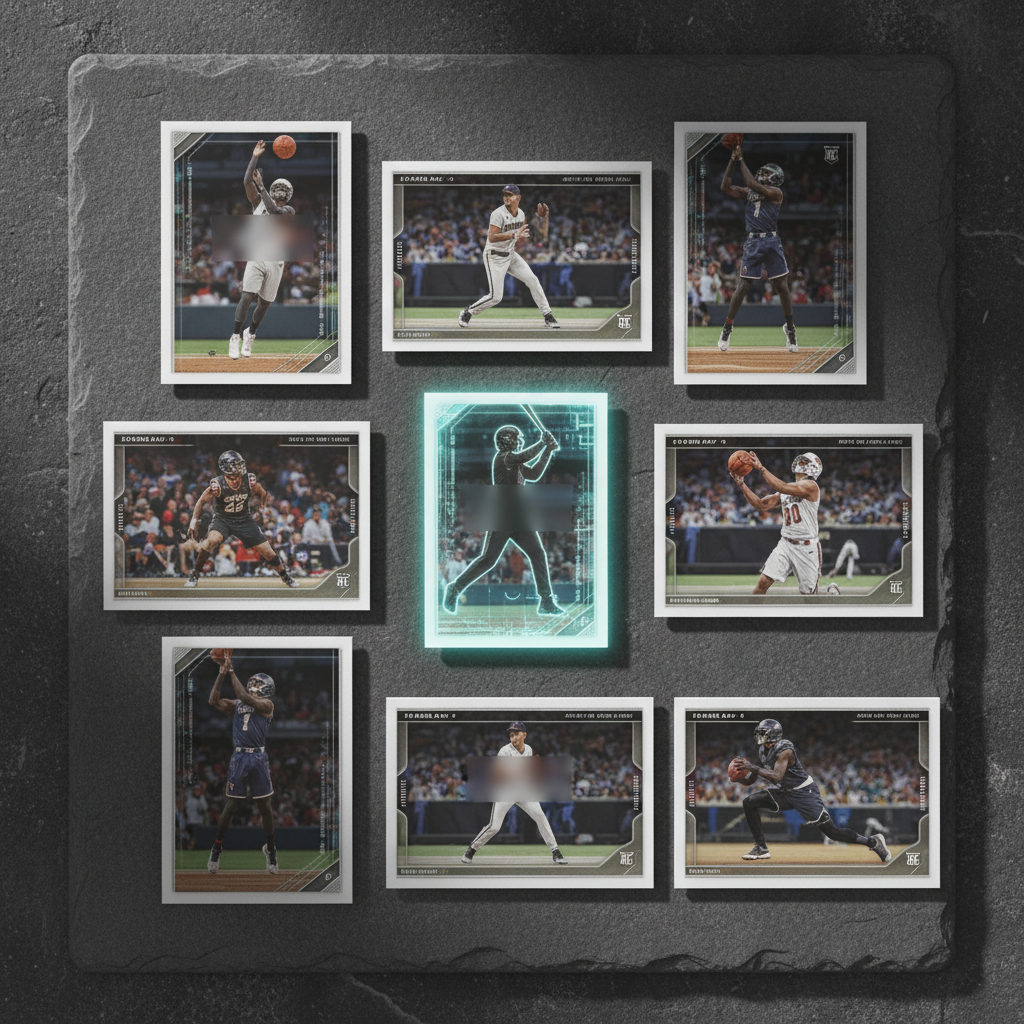
If you grade sports cards, centering is one of the first things you should check before sending anything off.
A card can look clean at first glance, but if the borders are off, that can hold the grade back straight away. That matters whether you are submitting vintage baseball, modern basketball, football rookies, or chrome cards with strong resale potential.
The good news is that centering is also one of the clearest parts of grading to measure.
Why centering matters in sports card grading
When collectors talk about grading, the four big condition areas are usually:
- Centering
- Corners
- Edges
- Surface
All four matter, but centering is the one that can be measured most objectively.
That makes it one of the best places to start when deciding whether a sports card is really worth submitting.
What does sports card centering mean?
Centering is simply how evenly the image sits within the borders of the card.
If one side is noticeably thicker than the other, or the top border is much bigger than the bottom, the card is off-center.
This is usually looked at in two directions:
- Left to right
- Top to bottom
A card might look fine in one direction but still be weak in the other, which is why centering needs to be checked properly rather than guessed by eye.
Why sports cards are worth checking carefully
Sports cards often carry strong grading upside, especially for:
- Rookie cards
- Low-pop modern parallels
- Vintage stars
- Clean chrome or refractor cards
- Cards collectors plan to sell after grading
Because of that, submission decisions can be expensive mistakes if you send cards blindly.
That is exactly why pre-grading matters.
How to check sports card centering by eye
A quick first check is to look at the borders around the front of the card.
Ask yourself:
- Does the left border look thicker than the right?
- Does the top border look thicker than the bottom?
- Does the image look shifted?
- Does anything feel obviously "off" right away?
This can help you eliminate very weak candidates quickly, but it is still only a rough starting point.
The problem with checking sports cards manually
A lot of collectors still rely on:
- Eyeballing the borders
- Using physical centering tools
- Manually placing lines on images
That works to a point, but it is slower and leaves more room for human error.
If you are sorting through multiple cards, or trying to make better grading decisions consistently, manual checking becomes a bottleneck very quickly.
What to watch for on sports cards specifically
Sports cards can bring a few extra headaches compared to some TCG cards.
Depending on the set, you may run into:
- Inconsistent borders
- Strong design elements that make centering harder to judge
- Busy backgrounds
- Chrome reflections
- Cards that look centered at first glance but are subtly shifted
That is why a proper sports card centering tool can be so useful. It helps remove some of the guesswork before you spend money on grading.
How CardCenter helps
CardCenter was built to help collectors make better pre-grading decisions by analysing centering automatically.
For sports cards, that means giving you a faster and more practical way to assess whether a card looks strong enough to submit before you send off your Topps, Panini, or Bowman cards.
Instead of grading blind, you can use a sports card centering tool to get a clearer read on whether the card is actually in the conversation for a strong grade.
Centering is not the whole grade, but it is the best place to start
It is important to remember that centering is only one part of the full grading process.
Corners, edges, and surface still matter a lot. A centered card with scratches, edge wear, or soft corners can still miss the grade you want.
But centering is often the easiest first filter.
If the centering is already weak, that may save you from wasting time and money before you even get deeper into the inspection.
Final thoughts
If you grade sports cards regularly, learning how to check centering properly is one of the most useful habits you can build.
It helps you:
- Avoid weaker submissions
- Be more selective
- Make better grading decisions
- Improve your chances of stronger outcomes
That is exactly why CardCenter exists.
Before you ship your next sports submission, use our sports card centering tool to see whether the card is really worth grading.
Frequently asked questions
The same standard PSA applies to all trading cards — approximately 55/45 or better on the front, 75/25 on the back. That tolerance applies whether the card is a Topps Chrome rookie, a Panini Prizm parallel, a Bowman Draft refractor, or a vintage Topps baseball card.
Yes, in two ways. First, chrome surfaces show scratches and print lines more easily under lights. Second, the reflective surface can make centering harder to judge by eye. A centering tool helps remove the visual confusion that chrome creates.
It matters even more. Vintage Topps, Bowman, and Fleer cards from the 1950s–1980s commonly have severe centering issues, which is why high-grade vintage examples are so rare and valuable. A well-centered vintage star can be worth multiples of an off-center copy.
Modern cardboard production runs at extreme speed, and even small alignment shifts during cutting create off-center cards. That is why high-grade modern rookies — especially first-print runs of Topps Chrome, Panini Prizm, and Bowman Chrome — still command premiums despite high print runs.
Yes, but the slab plastic can cause slight visual distortion. For the most accurate read, check centering before submission, while the card is raw. After grading, the subgrade or DIG report (where available) will tell you the official centering measurement.