
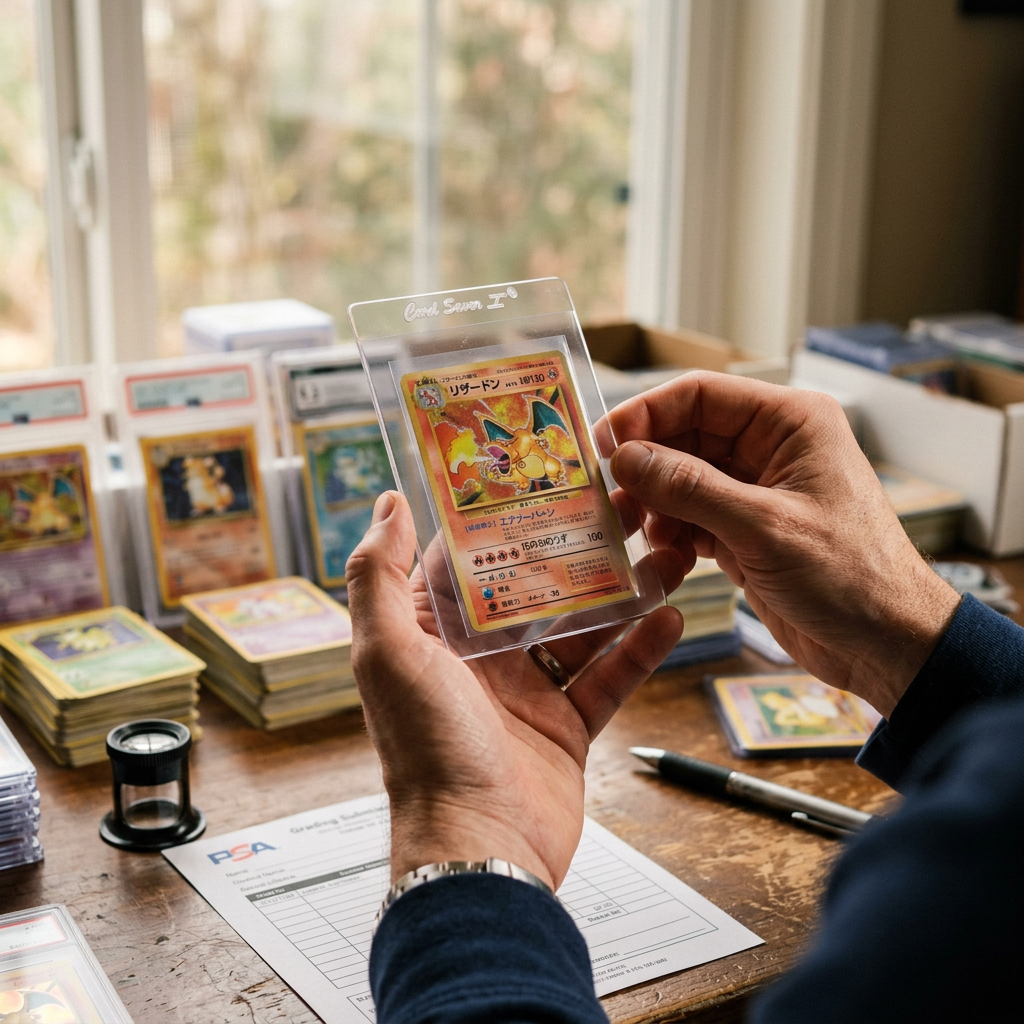
Updated May 2026. Should I grade this card? It is the single most expensive question in the hobby — and the one most collectors answer wrong. The average PSA submission costs $25–$50 per card, takes 4–8 weeks to return, and ends in a PSA 9 instead of a PSA 10 more often than not. Multiply that across a 20-card stack and the math gets brutal fast.
This guide gives you the exact 4-step pre-grading checklist used by collectors who consistently land Gem Mint 10s: a clear framework for deciding which cards belong in your next PSA, BGS, CGC, SGC, ACE, or TAG submission — and which ones should stay raw.
Should I grade this card? Quick answer
Yes — grade this card if all four are true: (1) the graded resale value is at least 2x the raw value plus grading fees, (2) it visually appears clean across centering, corners, edges, and surface, (3) the centering measures 55/45 or better on the front, and (4) there is real buyer demand at the higher grade. If any one of those fails, the card is usually better off staying raw or sold ungraded.
Why pre-grading saves you money on PSA submissions
Card grading is not cheap. PSA's standard service runs $25 per card, Beckett and CGC sit in the $20–$35 range, and SGC is comparable. Layer in shipping, insurance, and return postage and the real cost-per-card lands closer to $35–$50 for most collectors.
That is why pre-grading exists. It is not about predicting the exact grade — it is about filtering out the cards that have no realistic shot at the result that justifies the fee. Spend 5 minutes pre-grading and you can easily save $100+ per submission.
If you are grading Pokémon cards, the fastest first filter is our AI card centering tool — it gives you an objective centering measurement in under 10 seconds.
The 4-step pre-grading checklist
Every card goes through these four checks in order. If a card fails any step, it does not get submitted.
- Step 1 — Value check. Look up sold comps on eBay or 130point for both the raw card and the PSA 10 / BGS 9.5 version. If graded resale isn't at least 2x raw + grading fee, the math doesn't work.
- Step 2 — Centering check. Measure horizontal (left vs right) and vertical (top vs bottom) borders. A PSA 10 requires roughly 55/45 or better on the front. Outside that range, the card caps at PSA 9.
- Step 3 — Condition check. Under bright angled light, inspect corners (whitening, softness), edges (chipping, silvering), and surface (scratches, print lines, dents).
- Step 4 — Demand check. Are there active buyers? A PSA 10 of a card nobody wants is still a card nobody wants. Check eBay sold listings from the last 30 days for actual buyer activity.
Cards that pass all four steps get submitted. Everything else either stays raw, gets sold ungraded, or gets held for a future submission once condition or demand improves.
What are the four grading areas PSA evaluates?
Every major grading company — PSA, Beckett (BGS), SGC, CGC, ACE Grading, and TAG — evaluates trading cards across the same four condition areas:
- Centering — how evenly the printed image sits within the four borders (measurable mathematically)
- Corners — sharpness, whitening, bends, dings, or visible damage at all four corners
- Edges — chips, rough cuts, silvering, or wear along the perimeter of the card
- Surface — scratches, print lines, dents, stains, foil scratches, or marks on the card face
All four matter for the final grade, but centering is the only one you can measure mathematically from a photo. Corners, edges, and surface require in-hand inspection under strong angled light. That is why centering is the most efficient first filter — it can rule a card out faster than any other factor.
For the full measurement walkthrough, see our guide on how to check card centering.
Why centering is the smartest first filter
Out of the four grading areas, centering is the only one a collector can measure objectively at home. Corners, edges, and surface require subjective inspection, magnification, and experience to judge accurately. Centering is pure geometry — borders are either balanced or they are not.
This matters because centering is also a hard ceiling on the grade. A 1999 Base Set Charizard with perfect 50/50 centering can still grade PSA 8 if the corners are soft. But the inverse is more important: that same Charizard at 70/30 centering will almost never reach PSA 10, no matter how flawless the rest of the card looks.
That asymmetry is exactly why pre-grading starts with centering. If the card already fails the centering threshold, the rest of the inspection doesn't matter — you have your answer.
When grading a card is worth it
Grading usually makes financial sense when all of these line up:
- Raw value of $50+. Below that, fees usually eat the upside
- A clear graded comp. Recent sold listings prove buyers will pay the premium
- Strong centering. Front centering at 55/45 or better keeps PSA 10 on the table
- Clean visual condition. No obvious whitening, scratches, or edge wear
- Active demand. Cards selling within the last 30 days, not stale listings
Pokémon Base Set holos, modern alt arts, sports rookies (Trout, Luka, Mahomes), and vintage Topps stars are classic strong candidates when condition holds up. Sports collectors can run the same checklist using our sports card centering tool for Topps Chrome, Panini Prizm, and Bowman Chrome cards.
When grading a card is not worth it
Most cards do not belong in a submission. Common signals that a card should stay raw:
- Raw value under $20 and graded comps under 2x
- Visible whitening on any corner
- Centering clearly outside 60/40 on the front
- Print lines or surface scratches visible under angled light
- No recent sold comps — nobody is buying the graded version
- You are grading on hope or sentiment, not on math
That last one catches more collectors than any other. If the only reason to grade is "I really want this in a slab," the financial math has already told you the answer.
Common pre-grading mistakes
These are the mistakes that turn good submissions into bad ones:
- Grading through the sleeve. Sleeves and toploaders hide print lines, scratches, and edge wear. Always inspect raw.
- Skipping centering analysis. It takes 10 seconds and is the single most predictive factor.
- Trusting eBay 'mint' listings. Most raw cards listed as mint are actually PSA 8 candidates at best.
- Grading too soon after a hype event. Buyer demand spikes are often temporary. Comps from the spike can mislead.
- Bulk-grading low-value cards. Bulk tiers help, but if the raw card is worth $5, even $15 grading fees rarely make math work.
Fix these and your hit rate on strong grading outcomes climbs immediately.
How an AI centering tool speeds up the decision
The old way to check centering was a ruler, calipers, or a manual line tool. All three are slow and prone to placement error. Modern AI centering tools use computer vision to detect the outer card edge and inner art border automatically, then run the same worst-axis math graders use.
For Pokémon cards, the dedicated Pokémon card centering tool returns a centering ratio plus an estimated grade for PSA, BGS, SGC, CGC, ACE, TAG, and Get Graded in under 10 seconds. That is fast enough to run every card in a 50-card submission stack and ruthlessly cut the weak candidates before they cost you anything.
Pre-grading is a decision-making skill, not a guessing game
The collectors who consistently land Gem Mint 10s are not luckier — they are more selective. They run every card through the same checklist, they trust the math, and they say no to most submissions.
When pre-grading becomes a habit, the results compound:
- Higher percentage of PSA 10 outcomes
- Fewer wasted grading fees
- Stronger resale margins on the cards they do submit
- More confident buy/sell/hold decisions
- Better long-term collection ROI
Selective grading is the single highest-leverage habit in the hobby.
Frequently asked questions
PSA's standard service starts around $25 per card, with bulk submissions sometimes dropping below $20. Beckett, CGC, and SGC fall in a similar range. Shipping, insurance, and return postage usually add $5–$15 per submission on top.
PSA's standard turnaround typically runs 20–45 business days, while bulk service can stretch to 65+ business days during busy periods. Express and walk-through services return faster but cost significantly more per card.
Usually not. Once you factor in grading fees, shipping, and return postage, a $10 raw card needs to roughly triple in graded value just to break even — and that requires a strong grade, not just any grade.
Generally the strongest candidates are high-grade vintage holos (Base Set, Jungle, Fossil), modern chase cards (alt arts, full arts, secret rares), promo cards with strong demand, and any card with proven graded comps that justify the fee.
Yes, but be careful — many online cards arrive with edge wear, surface marks, or centering issues not visible in listing photos. Always inspect the card in hand before submitting, and check centering before paying any grading fee.
Final thoughts: should you grade this card?
Not every card belongs in a PSA, BGS, or CGC submission. The cards that should be graded share the same fingerprint: strong centering, clean condition, real buyer demand, and graded resale that comfortably clears the cost of grading.
That is what the 4-step pre-grading checklist is built to identify. Run every card through it, trust the math, and your submission outcomes will get measurably better.
Ready to filter your next submission stack? Try the free AI card centering tool and pre-grade your next card in under 10 seconds — before you spend a dollar on grading fees.