
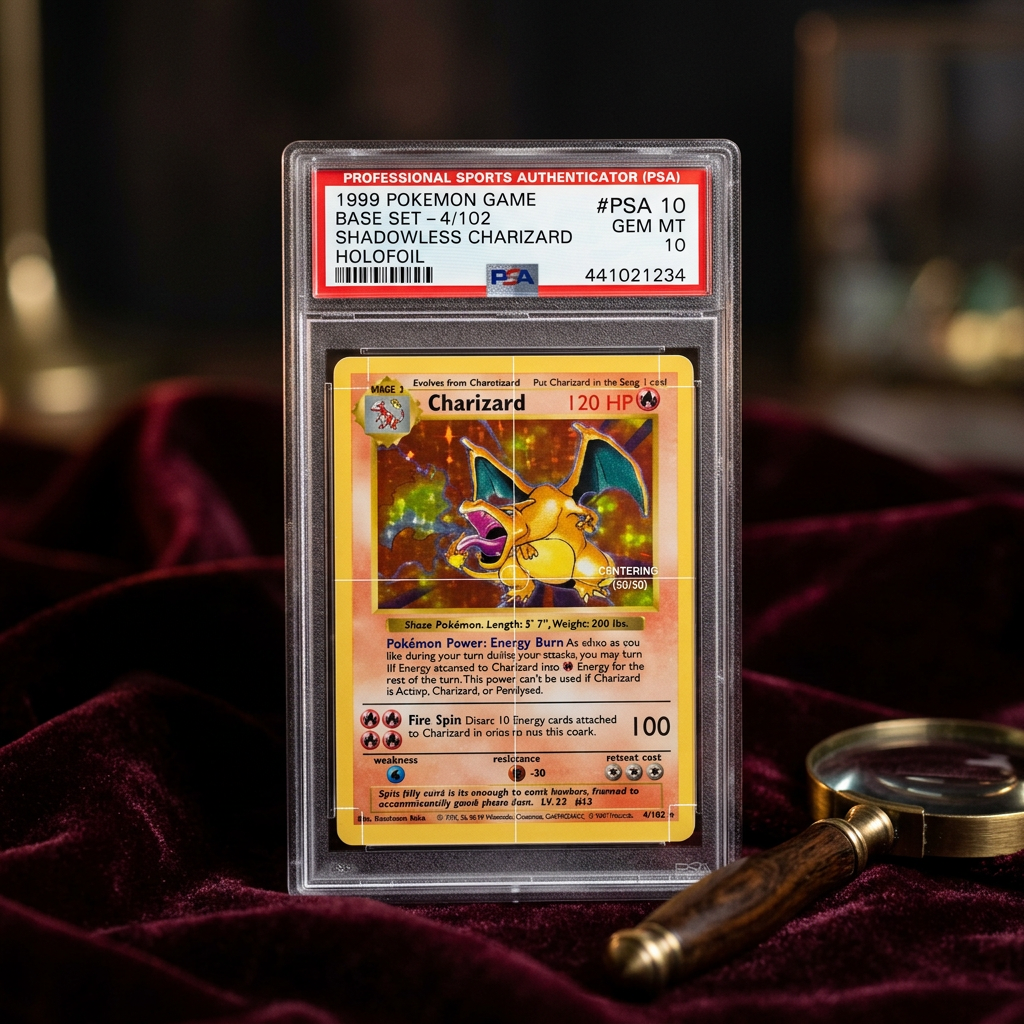
Updated May 2026. PSA 10 centering is the single hardest condition factor to fake your way past. A 1999 Base Set Charizard with razor-sharp corners and a flawless surface will still grade PSA 9 if the borders are off — and unlike the other condition factors, centering can be measured to the millimeter before you ever drop a card in the mail.
This guide breaks down exactly what PSA 10 centering requires: the official 55/45 front and 75/25 back tolerances, how PSA actually measures centering, what 55/45 looks like in real life, and the fastest free way to pre-check before you spend a dollar on grading fees.
What centering do you need for a PSA 10?
PSA's published grading standards require a Gem Mint 10 card to be centered no worse than approximately 55/45 on the front and 75/25 on the back. That means one border can be up to 55% of the combined border width on the front, and up to 75% on the back. Anything outside those tolerances caps the card at a PSA 9, regardless of how clean the corners, edges, and surface are.
PSA 10 centering standards explained
PSA grades every trading card across four condition areas: centering, corners, edges, and surface. A PSA 10 (Gem Mint) requires near-perfection across all four, and PSA's official grading guide describes a 10 as having "approximately 55/45 to 60/40 centering on the front" — though the cleaner end of that range is what most successful Gem Mint submissions actually measure.
PSA determines centering by comparing left-to-right and top-to-bottom border measurements. Both axes are evaluated. The grade is set by the worst axis — not the average. A card with 50/50 vertical centering and 65/35 horizontal centering is graded on the 65/35.
In practical terms:
- Front of the card: must measure 55/45 or better on both axes
- Back of the card: more forgiving — up to 75/25 still qualifies
- Both left/right and top/bottom are measured separately
- The worst-performing axis sets the centering subgrade
If a card is clearly off-center to the eye on the front, especially in side-by-side comparison with a known-centered example, it is almost always already outside PSA 10 territory.
What does 55/45 centering actually look like?
A 55/45 ratio sounds technical but the visual reality is subtle. If the total left + right border space is 4mm, a 55/45 card has one side at 2.2mm and the other at 1.8mm. To the naked eye, the difference is almost imperceptible.
Here is how the centering scale plays out on a typical Pokémon or sports card:
- 50/50 — perfectly centered, eligible for any grade up to Pristine 10 / Black Label
- 52/48 or 53/47 — visually flawless, comfortable PSA 10 territory
- 55/45 — right at the PSA 10 boundary, still inside tolerance
- 60/40 — visibly off-center, almost always caps at PSA 9
- 65/35 — clearly off, PSA 8 territory at best
- 70/30 or worse — PSA 7 or lower from centering alone
This is exactly why centering is so useful in pre-grading. Unlike corners or surface, you can run a centering check in 10 seconds with the AI card centering tool and get an objective number before you commit to a submission fee.
PSA 10 vs PSA 9: how centering decides the grade
The difference between a PSA 10 and PSA 9 is rarely dramatic — it is usually one small flaw across centering, corners, edges, or surface. But of those four, centering is the most common reason a card drops from a 10 to a 9.
Here is the centering tolerance comparison across major PSA grades:
- PSA 10 (Gem Mint): approximately 55/45 front, 75/25 back
- PSA 9 (Mint): approximately 60/40 front, 90/10 back
- PSA 8 (Near Mint-Mint): approximately 65/35 front, 90/10 back
- PSA 7 (Near Mint): approximately 70/30 front, 90/10 back
The gap between a 55/45 (PSA 10) and a 60/40 (PSA 9) is only 5 percentage points — but on a high-value card like a Trout rookie, an alt art Charizard, or a 1986 Fleer Jordan, that 5 points can be the difference between a $500 sale and a $5,000 sale.
Why centering is the smartest pre-grading filter
Centering is the only condition factor a collector can measure mathematically from a photo. Corners, edges, and surface all require in-hand inspection under magnification and angled light. Centering is pure geometry — you measure the borders, divide, and you have your answer.
That means centering is the fastest, cheapest, and most reliable first filter. If a card already fails the 55/45 threshold, the rest of the inspection doesn't matter for PSA 10 purposes. You have your answer in under 10 seconds.
For the complete step-by-step measurement walkthrough, see our guide on how to check card centering. And if you are unsure whether the card is even worth submitting at all, our companion guide on should I grade this card covers the broader decision framework.
What else can stop a PSA 10?
Meeting the centering threshold is necessary but not sufficient. A PSA 10 also requires near-perfection across the other three condition areas:
- Corners — no whitening, no softness, no bends, no dings at any of the four corners
- Edges — no chipping, no silvering, no rough cuts, no wear along the perimeter
- Surface — no scratches, no print lines, no dents, no stains, no foil scratches on chrome or refractor cards
Surface is the most commonly missed factor at home because small print lines and foil scratches are only visible under strong angled light. A card that passes centering at 53/47 can still come back PSA 9 from a single hairline scratch that wasn't visible under direct overhead light. That is why a proper pre-grade always combines AI centering analysis with manual surface inspection.
How to pre-check PSA 10 centering
There are four ways collectors check centering before submission:
- By eye — fast but unreliable, easy to misjudge subtle differences
- Ruler or calipers — accurate but slow, especially across a 20-card stack
- Manual line tools — require dragging four borders yourself, prone to placement error
- AI centering tools — automatic edge detection, worst-axis math, results in seconds
Manual methods can work but they take time and introduce human error. A single pixel of misplacement can shift a 55/45 PSA 10 candidate to a 60/40 PSA 9 in the measurement — even when the card itself hasn't changed. That is why the modern standard is AI-based: use the dedicated Pokémon card centering tool for Pokémon submissions, or the sports card centering tool for Topps, Panini, Bowman, and Upper Deck cards.
How CardCenter pre-grades for PSA 10
CardCenter uses computer vision to detect the outer card edge and the inner art border automatically, then runs the same worst-axis math PSA graders apply. The result is an objective centering ratio plus an estimated PSA grade in under 10 seconds per card.
The output answers the only question that matters before submission:
Does this card have realistic PSA 10 centering potential?
If the answer is yes, the card is worth the deeper corner, edge, and surface inspection. If the answer is no, the card stays raw and your $25 grading fee stays in your pocket. That is what selective grading actually looks like.
Frequently asked questions
PSA's published grading standards allow a Gem Mint 10 card to be centered no worse than approximately 55/45 on the front and 75/25 on the back. Anything outside those tolerances usually caps the card at a PSA 9.
No. 50/50 is perfect centering, but PSA does not require it for a 10. You only need to fall inside the 55/45 tolerance on the front. A card at 53/47 or 54/46 is well within PSA 10 range from a centering standpoint.
Not usually. If the centering is clearly outside 55/45 on the front, the card is almost always capped at a PSA 9 — even if corners, edges, and surface are flawless. Centering is a hard ceiling on the grade.
Yes. PSA evaluates both sides, but the front carries the stricter tolerance (55/45) while the back is more forgiving (75/25). Back centering rarely decides a grade unless it is severely off.
The most common reasons are centering just outside tolerance, a single soft corner, light edge whitening, or a small surface scratch that is hard to see without strong lighting. Pre-grading helps catch these before submission.
Final thoughts: PSA 10 centering in 2026
PSA 10 centering requires approximately 55/45 or better on the front and 75/25 or better on the back — combined with near-perfect corners, edges, and surface. That single math threshold decides more PSA 10 outcomes than any other condition factor.
It is also the only factor you can measure objectively at home, which is exactly why every smart submission starts with a centering check. The faster and more accurate that check is, the more selectively you grade — and the better your overall PSA 10 hit rate becomes.
Ready to stop grading blind? Run your next card through the free AI card centering tool before you spend a dollar on grading fees.