
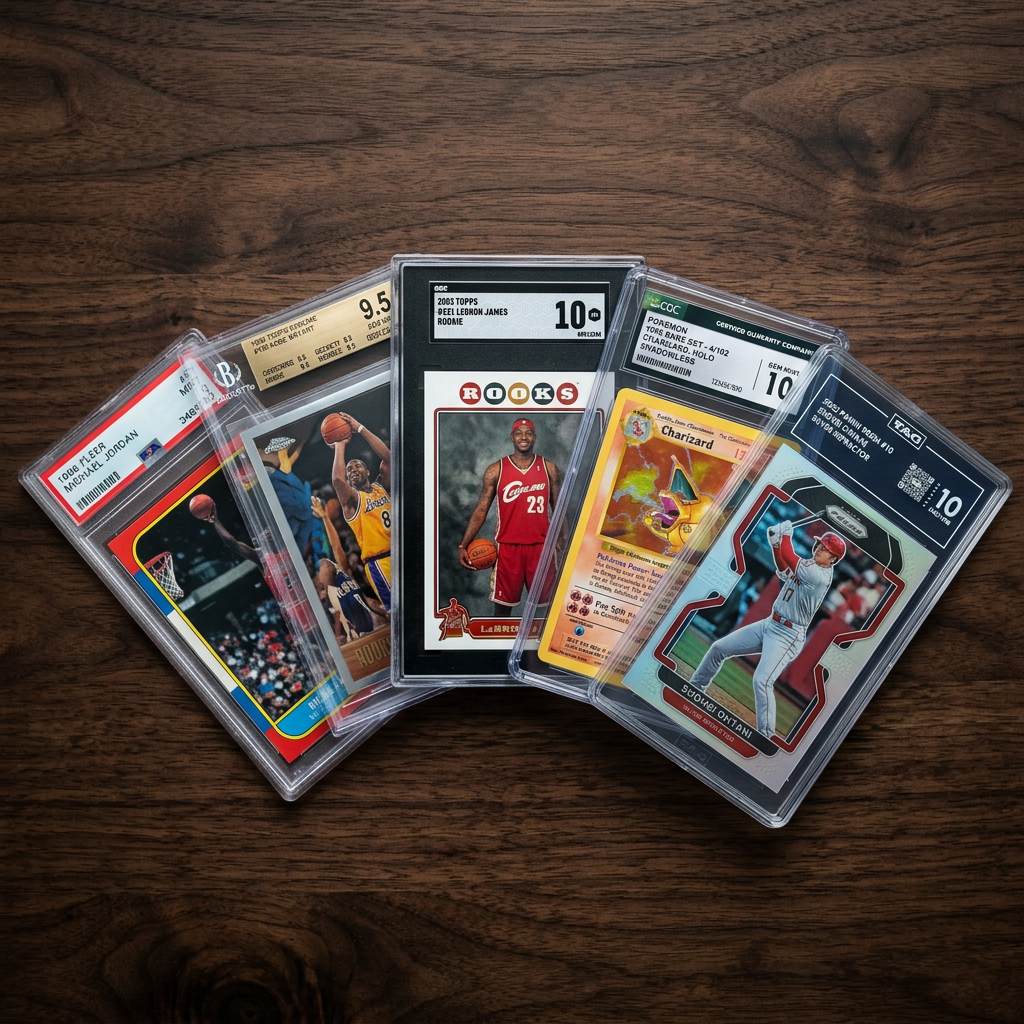
Updated May 2026. Choosing the right Pokémon card grading company is a five-figure decision over the lifetime of a serious collection. PSA, Beckett (BGS), CGC, ACE Grading, and TAG all grade the same four condition areas — centering, corners, edges, and surface — but they differ massively on cost, turnaround time, slab design, resale premium, and grading philosophy.
This guide compares all five head-to-head: who they are, what they cost, how long they take, what their slabs look like, and — most importantly — which one is right for your specific cards and goals.
Which Pokémon grading company is best in 2026?
PSA remains the top choice for maximum resale value, especially on vintage holos and modern chase cards. Beckett (BGS) wins for subgrade detail. CGC offers strong value and turnaround. ACE Grading leads on slab and label design, particularly for UK collectors. TAG is the choice for collectors who prioritize transparency and digital grading reports. Your best fit depends on whether you grade to sell, to display, or to authenticate.
Why your grading company choice matters
Collectors grade Pokémon cards for five main reasons:
- To increase resale value through certified condition
- To make cards easier to sell with buyer-trusted authentication
- To protect cards in a tamper-evident slab
- To preserve high-value cards long term
- To build a graded collection or registry set
But grading is not just about sending a card to any company. The grader you choose affects resale price, slab presentation, grading transparency, turnaround speed, and how the cardboard market perceives the final result. A PSA 10 of a 1999 Base Set Charizard sells for materially more than a CGC 10 or BGS 9.5 of the same card — even though all three represent top-grade outcomes.
PSA (Professional Sports Authenticator)
PSA is the largest, most recognised trading card grading company in the world and the benchmark almost every other grader is compared against. PSA grades across the standard four condition areas — centering, corners, edges, and surface — and publishes its 55/45 front and 75/25 back centering tolerance as part of its official standards.
PSA at a glance:
- Cost: Bulk from ~$15, Value $25, Regular $75, Express $150+
- Turnaround: Bulk 65+ business days, Value 45 business days, Express 5–10 business days
- Best for: Vintage Pokémon, modern chase cards, anything graded primarily to resell
- Resale premium: Highest in the market for most Pokémon and sports cards
- Slab style: Traditional red label, instantly recognisable globally
PSA is the default for resale-focused submissions because the secondary market overwhelmingly prices PSA 10s above equivalent BGS 9.5 or CGC 10 grades — especially on iconic cards like Base Set Charizard, Pikachu Illustrator, and modern alt arts. For PSA's exact centering requirements, see our guide on what centering do you need for a PSA 10.
Beckett (BGS)
Beckett Grading Services (BGS) is the go-to grader for collectors who want subgrades — individual scores for centering, corners, edges, and surface displayed on the slab itself. This is the key differentiator: BGS shows you exactly why a card scored what it did, instead of giving you a single overall number.
BGS at a glance:
- Cost: Base from ~$20, Standard ~$50, Express $125+
- Turnaround: Standard ~30 business days, Express 5–10 business days
- Best for: Collectors who value subgrade transparency, modern chase cards, BGS 10 Pristine and Black Label chasers
- Resale premium: Strong on Black Label (BGS 10) and 9.5 with strong subgrades, lower on standard BGS 9
- Slab style: Distinctive coloured labels (gold for 9.5, silver for 9, black for Pristine 10)
Beckett's BGS 10 Pristine — the elusive Black Label — requires four perfect 10 subgrades and is one of the rarest grading outcomes in the hobby. Collectors who chase Black Labels almost always submit through BGS specifically for that opportunity. Centering tolerances are slightly stricter than PSA: BGS 10 Pristine requires 50/50 on the front and 55/45 on the back.
CGC (Certified Guaranty Company)
CGC grew out of comic book grading and expanded into trading cards in 2020, quickly becoming a major Pokémon and TCG option. CGC offers competitive pricing, faster turnaround than PSA, and a clean modern slab — making it a popular choice for cost-conscious collectors who still want a recognised brand.
CGC at a glance:
- Cost: Bulk from ~$15, Modern ~$25, Express $75+
- Turnaround: Generally faster than PSA at the same tier — often 20–30 business days for standard service
- Best for: Cost-conscious collectors, faster turnaround needs, TCG specialists
- Resale premium: Below PSA on most cards but improving — gap narrowing on modern and TCG
- Slab style: Clean, modern, with optional Perfect 10 designation for flawless cards
CGC is often the smartest choice when you want a recognised grading brand without PSA's longer turnaround or higher fees. It is particularly popular among collectors grading Pokémon TCG, Magic: The Gathering, and Yu-Gi-Oh! cards in bulk.
SGC (Sportscard Guaranty Company)
SGC is a long-established grading company with a strong reputation for vintage sports cards — and increasingly, vintage Pokémon. SGC's iconic black-borders slab (the "tuxedo") is instantly recognisable and a favourite for collectors who value display presentation alongside the grade itself.
SGC at a glance:
- Cost: Economy from ~$15, Standard ~$30, Express $75+
- Turnaround: Often the fastest of the major graders — Standard service typically 10–25 business days
- Best for: Vintage cards, fast turnaround, distinctive slab presentation
- Resale premium: Strong on vintage, growing on modern, generally below PSA
- Slab style: Black-border "tuxedo" — premium-feeling and display-friendly
SGC has become the go-to alternative to PSA for vintage submissions, with many serious vintage collectors splitting submissions between the two. SGC is also often used as a fast-turnaround alternative when PSA backlogs stretch beyond acceptable wait times.
ACE Grading
ACE is especially relevant in the UK and positions itself around modern, consistent, and transparent trading card grading. ACE's own materials emphasise accurate grading, published grading reports, objective centering measurement, and clear distinctions between objective and subjective grading. ACE says its centering is measured objectively to within 1/1000th of a millimeter and calculated into its grading formula.
ACE also stands out heavily on presentation. The company promotes its premium crystal-clear slab as both protective and visually appealing, and one of its most distinctive features is its ACE Labels. ACE describes these labels as bespoke, in-house illustrated add-ons that extend and enhance the card's design, making them a major part of the brand's identity and collector appeal.
Why collectors use ACE
- Strong UK presence
- Transparency and grading reports
- Objective centering emphasis
- Premium slab presentation
- Distinctive ACE Labels that many collectors specifically like for display
ACE is not just competing on grading alone. It also competes on how the finished slab looks in a collection. For a lot of collectors, especially in the UK, the label design and slab presentation are a real part of the appeal, not just an extra.
TAG
TAG positions itself very differently from traditional grading companies. TAG describes itself as Technical Authentication & Grading and says it uses patented computer vision technology, transparent grading, and digital reports to provide a more objective grading experience. TAG offers both an industry-standard 10-point grading scale through TAG X and its own score-based system on certain services.
One of TAG's biggest differentiators is its DIG report, short for Digital Image & Grading Report. TAG says these reports provide a highly detailed condition analysis and grading breakdown, accessible via the slab's QR code or certification lookup. TAG also promotes its slabs as aesthetically inscribed and made from crystal-clear, UV- and abrasion-resistant acrylic.
Why collectors use TAG
- Technology-led grading approach
- Strong emphasis on transparency and objective scoring
- Detailed digital grading reports
- Modern slab design
- Attractive for collectors who value data and accountability behind a grade
TAG appeals strongly to collectors who want to understand why a card received its grade, not just what the final number is. The digital report and technology-first positioning are a major part of its appeal.
Which grading company should I choose?
There is no universal "best" — the right grading company depends on your specific goal:
Choose PSA if you grade primarily to resell. PSA carries the strongest secondary-market premium on Pokémon, sports, and vintage cards, especially at the PSA 10 level.
Choose BGS (Beckett) if you want subgrade detail visible on the slab, or if you are chasing the Black Label Pristine 10 — the rarest grade in the hobby.
Choose CGC if you want a recognised brand at lower cost and faster turnaround. CGC is particularly strong for bulk TCG submissions like Pokémon, Magic: The Gathering, and Yu-Gi-Oh!.
Choose SGC if you grade vintage cards or need fast turnaround. SGC's tuxedo slab is also a display favourite for premium collections.
Choose ACE if you are UK-based, value premium slab and label design, or want objective centering measurement built into the grade.
Choose TAG if you want maximum grading transparency through detailed digital DIG reports — a modern, data-led approach to authentication.
Cost and turnaround compared
Across the five graders, costs and turnaround times vary significantly. Approximate figures for 2026:
- PSA Value: ~$25 per card, 45 business days
- BGS Standard: ~$50 per card, 30 business days
- CGC Modern: ~$25 per card, 20–30 business days
- SGC Standard: ~$30 per card, 10–25 business days
- ACE Standard: varies by service tier, generally a few weeks to a few months
- TAG Standard: varies by service tier, generally a few weeks
Always check each grader's official site for current pricing and turnaround before submitting — these change frequently based on volume and seasonal backlogs.
Pre-grading: the step before any of them
No matter which grading company you choose — PSA, BGS, CGC, SGC, ACE, or TAG — the question that comes first is the same:
Is this card actually worth submitting?
That is where pre-grading saves serious money. Every grader uses the same four condition areas (centering, corners, edges, surface), and centering is the only one a collector can measure objectively from home. If a card already fails the centering threshold for the grade you want, no choice of grading company will rescue it.
That is exactly why our AI card centering tool was built. Run every card through it before you decide which grader to send to — and which cards to skip entirely. For the full pre-grading framework, see our companion guide on should I grade this card.
Frequently asked questions
PSA is the most widely recognised and usually resells at the highest premium, especially for vintage holos and modern chase cards. Beckett, CGC, ACE, and TAG all have strong followings depending on what you value — slab design, subgrades, transparency, or speed.
In most secondary markets, yes. A PSA 10 Pokémon card typically sells for more than the same card in a CGC 10 or BGS 9.5, though the gap varies by set and era. For vintage especially, PSA carries the strongest resale premium.
Yes. ACE is a recognised UK-based grading company with published standards, objective centering measurement, and a strong collector following — particularly in the UK and European markets. Its slabs and labels are popular with collectors who prioritise display.
Bulk submissions to PSA, CGC, or ACE typically offer the lowest per-card cost, often $15–$20 each with longer turnaround. SGC is also competitive on price. Compare current bulk tier rates directly on each company's website before submitting.
TAG is newer to the hobby and its resale premiums are still developing. It is popular with collectors who value transparency and digital DIG reports, but for pure resale, PSA remains the market leader for most Pokémon and sports cards.
Final thoughts: choosing your grader in 2026
PSA, Beckett, CGC, SGC, ACE, and TAG all serve real and distinct purposes in the modern grading market. PSA leads on resale value. Beckett wins on subgrade detail and Black Label chases. CGC and SGC compete strongly on cost and turnaround. ACE leads on slab and label aesthetics, especially for UK collectors. TAG pushes hardest on data-led transparency.
But before any of them, the smartest step is the same: pre-grade the card. Centering is the only condition factor you can measure objectively from home, and it is the single most common reason cards miss the grade their owner expected.
Run your next submission stack through the free AI card centering tool before you choose a grader. Filter ruthlessly, submit selectively, and your grading outcomes — at any company — will get measurably better.