
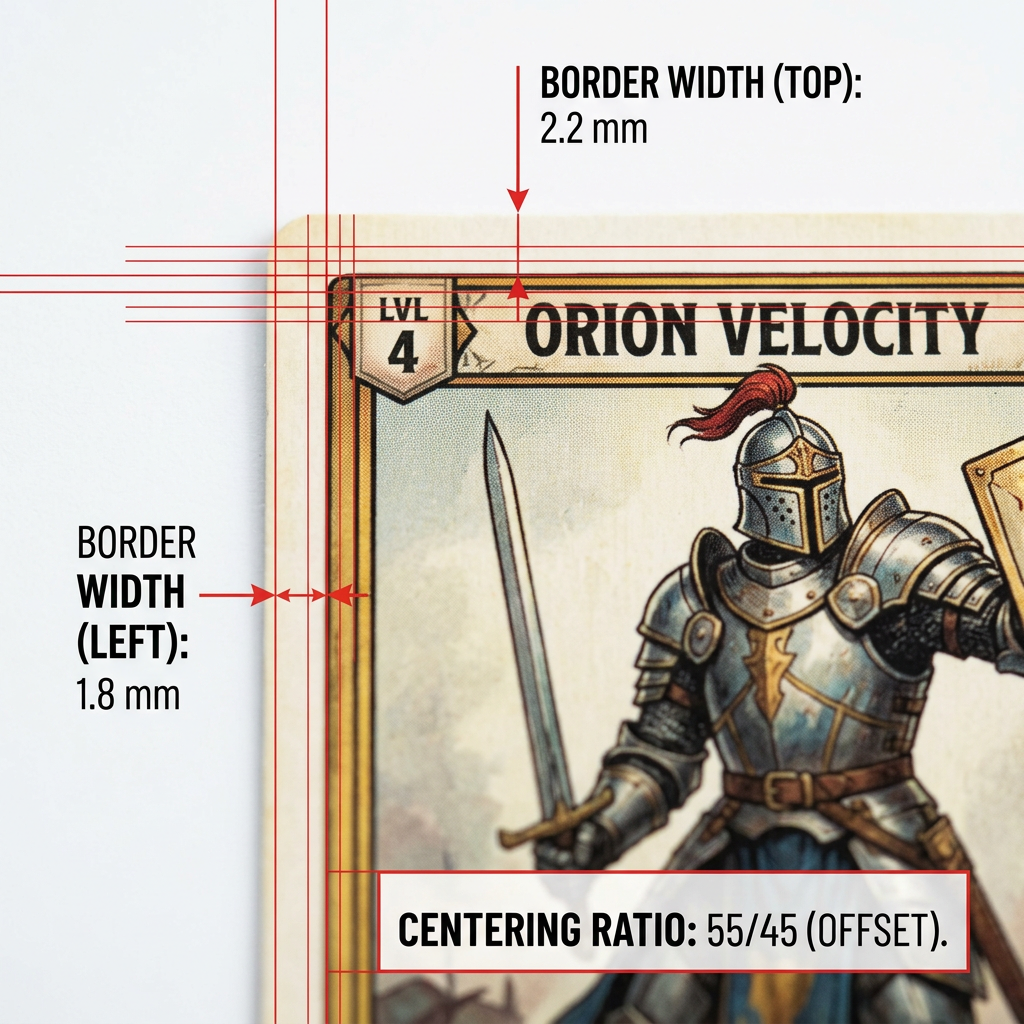
Updated May 2026. Card centering ratios are the single most predictable part of trading card grading. A 50/50 Pokémon Base Set Charizard is a Gem Mint 10 candidate. A 60/40 version of the same card is almost always a PSA 9. The difference between those two ratios — just 10 percentage points of border imbalance — can mean the difference between a $5,000 sale and a $500 sale.
This guide breaks down exactly what card centering ratios mean, how to read them, which thresholds each grading company uses, and why even tiny differences like 55/45 vs 56/44 matter so much to serious collectors.
What is a card centering ratio?
A card centering ratio compares the width of one border to the width of the opposite border, expressed as percentages that add up to 100. A 50/50 ratio means perfect centering — both borders are exactly the same width. A 55/45 ratio means one border is 55% of the combined border space and the opposite border is 45%. Grading companies measure both axes (left/right and top/bottom) and grade the worst one.
How card centering ratios are calculated
The math is simple. Measure one border, divide it by the sum of both opposite borders, and multiply by 100.
Example: Left border = 2.2mm, right border = 1.8mm. Combined = 4.0mm. Left percentage = 2.2 ÷ 4.0 × 100 = 55%. Right percentage = 1.8 ÷ 4.0 × 100 = 45%.
That card is 55/45 horizontal. Repeat the same calculation top to bottom for vertical centering. Every modern grading company — PSA, BGS, CGC, SGC, ACE, TAG — uses this same method.
The key rule: the worst axis sets the grade. A card that is 50/50 vertically but 65/35 horizontally is graded on the 65/35. PSA, Beckett, and SGC do not average the two axes — they take the worst one.
For the full step-by-step measurement walkthrough, see our guide on how to check card centering.
The complete centering ratio scale
Here is how every common centering ratio plays out on a typical Pokémon or sports card front:
- 50/50 — Perfect. Eligible for any grade up to BGS Black Label 10 / TAG Pristine
- 52/48 or 53/47 — Visually flawless. Comfortable PSA 10 territory
- 55/45 — Right at the PSA 10 boundary. Still inside Gem Mint tolerance
- 57/43 — Borderline. Front-of-card is visibly slightly off
- 60/40 — Clearly off-center. Caps at PSA 9 (Mint) in most cases
- 65/35 — Strongly off. PSA 8 (Near Mint-Mint) territory
- 70/30 — Heavy imbalance. PSA 7 or lower from centering alone
- 80/20 or worse — Approaching miscut territory
Back-of-card centering follows the same scale but with much more tolerance. PSA allows up to 75/25 on the back of a PSA 10, and 90/10 on the back of a PSA 9. Back centering rarely decides a grade — front centering almost always does.
Is 55/45 good centering?
Yes. 55/45 is considered strong centering across every major grading company and falls within PSA 10 tolerance on the front of the card. It is the threshold that separates PSA 10 candidates from PSA 9 candidates on most modern cards.
That said, 55/45 is not the same as 50/50:
- For PSA 10: Acceptable, but on the edge. Many cards at exactly 55/45 still receive a PSA 9 if other factors are borderline
- For BGS 9.5 (Gem Mint): Within tolerance, especially when other subgrades are 9.5+
- For BGS Black Label 10: Not enough — Black Label requires 50/50 front
- For SGC 10: Within tolerance, similar to PSA
- For CGC 10: Within tolerance
- For ACE 10: Within tolerance
If you want to understand PSA's exact thresholds across all 10 grade levels, see our detailed breakdown of what centering you need for a PSA 10.
Is 60/40 bad centering?
Not catastrophic, but it crosses an important line. 60/40 is generally outside PSA 10 tolerance on the front, which means the card caps at PSA 9 even if corners, edges, and surface are flawless. On the back of the card, 60/40 is still well within tolerance for any major grade.
What 60/40 means for your card depends on context:
- If you are chasing PSA 10: 60/40 is the deal-breaker. Save your submission fee
- If you are happy with PSA 9: 60/40 is fine and a strong 9 is still a valuable grade
- If the issue is on the back only: Centering is unlikely to affect the grade
- If you are grading for personal collection: 60/40 may not matter to you
- If you plan to resell: Be honest about the grade ceiling before submitting
60/40 is the centering threshold where pre-grading saves the most money. Cards at this ratio look fine to the casual eye but will not earn a Gem Mint result — and identifying them before submission is exactly what an AI card centering tool is designed to do.
Why do collectors obsess over small ratio differences?
To someone outside the hobby, the difference between 55/45 and 57/43 seems trivial. To a serious collector, that 2-point swing can be the boundary between a $2,000 sale and a $500 sale. Here's why:
- PSA 10 vs PSA 9 multiples: Modern chase cards (Pikachu alt arts, Trout rookies, Mahomes Prizm rookies) often sell at 3–10x the PSA 9 price as a PSA 10
- Black Label scarcity: BGS Black Label requires perfect 50/50 on the front — one of the rarest grading outcomes in the hobby
- Vintage premiums: High-grade vintage cards (1986 Fleer Jordan, 1999 Base Set Charizard) carry massive centering premiums
- Submission economics: A $25 grading fee against a 5-point centering swing has serious leverage when graded comps differ by thousands
That is why centering ratios get more attention than any other condition factor. They are objective, measurable, and they translate directly into dollars.
Centering ratio thresholds by grading company
Here is how the major grading companies treat centering ratios at the top of the scale:
- PSA 10 (Gem Mint): ~55/45 front, ~75/25 back
- BGS 10 Pristine (Black Label): 50/50 front, ~55/45 back
- BGS 9.5 Gem Mint: ~55/45 front, ~60/40 back
- SGC 10 Pristine: ~55/45 front, ~75/25 back
- CGC 10 Pristine: ~55/45 front, ~75/25 back
- TAG Pristine 10: Strict centering thresholds with full digital DIG report transparency
- ACE 10: Objective centering measurement to 1/1000th of a millimeter per ACE's stated standards
These thresholds shift slightly across categories (vintage vs modern, sports vs TCG), but the 55/45 line remains the dominant Gem Mint benchmark across the industry.
How to measure your card's centering ratio
Three options, from slowest to fastest:
- Ruler or digital calipers: Accurate but slow — manually measure each border in millimeters
- Manual line tools: Drag four borders over a photo yourself. Faster than rulers but prone to placement error
- AI centering tools: Computer vision auto-detects all four borders. Results in under 10 seconds
For Pokémon submissions, the dedicated Pokémon card centering tool returns the exact horizontal and vertical ratio plus an estimated PSA, BGS, SGC, CGC, ACE, TAG, and Get Graded grade. Sports collectors can run the same workflow through the sports card centering tool for Topps Chrome, Panini Prizm, Bowman Chrome, and Upper Deck cards.
Frequently asked questions
50/50 is perfect — borders are equal on both sides. Anything between 50/50 and 55/45 is strong centering and qualifies for PSA 10. Once you cross 60/40, the card almost always caps at PSA 9 or lower.
Yes — and most cards do. A card might be 52/48 horizontal but 60/40 vertical. Grading companies take the worst axis as the centering grade, not the average of the two.
Much less than front. PSA allows up to 75/25 on the back of a PSA 10, which is far more forgiving than the 55/45 front requirement. Back centering only matters if it is severely off (90/10 or worse).
Divide one border by the sum of both opposite borders, then multiply by 100. Example: 2.2mm ÷ (2.2mm + 1.8mm) × 100 = 55%. Repeat for the opposite axis.
Because centering is only one of four condition factors. Two cards both at 55/45 can grade differently if one has soft corners, edge whitening, or surface print lines. Centering sets the ceiling — the other factors decide whether the card actually hits it.
Final thoughts: centering ratios are the math behind your grade
Card centering ratios are not just trivia — they are the most predictable part of trading card grading. The closer you are to 50/50, the higher your ceiling. 55/45 is strong. 60/40 caps you at PSA 9. 65/35 caps you at PSA 8.
Learning to read these ratios is one of the highest-leverage habits in pre-grading. The collectors who consistently land Gem Mint 10s are the ones who measure first and submit second.
Ready to see your card's exact ratio? Run it through the free AI card centering tool and get an objective measurement plus an estimated grade in under 10 seconds — before you spend a dollar on grading fees.