
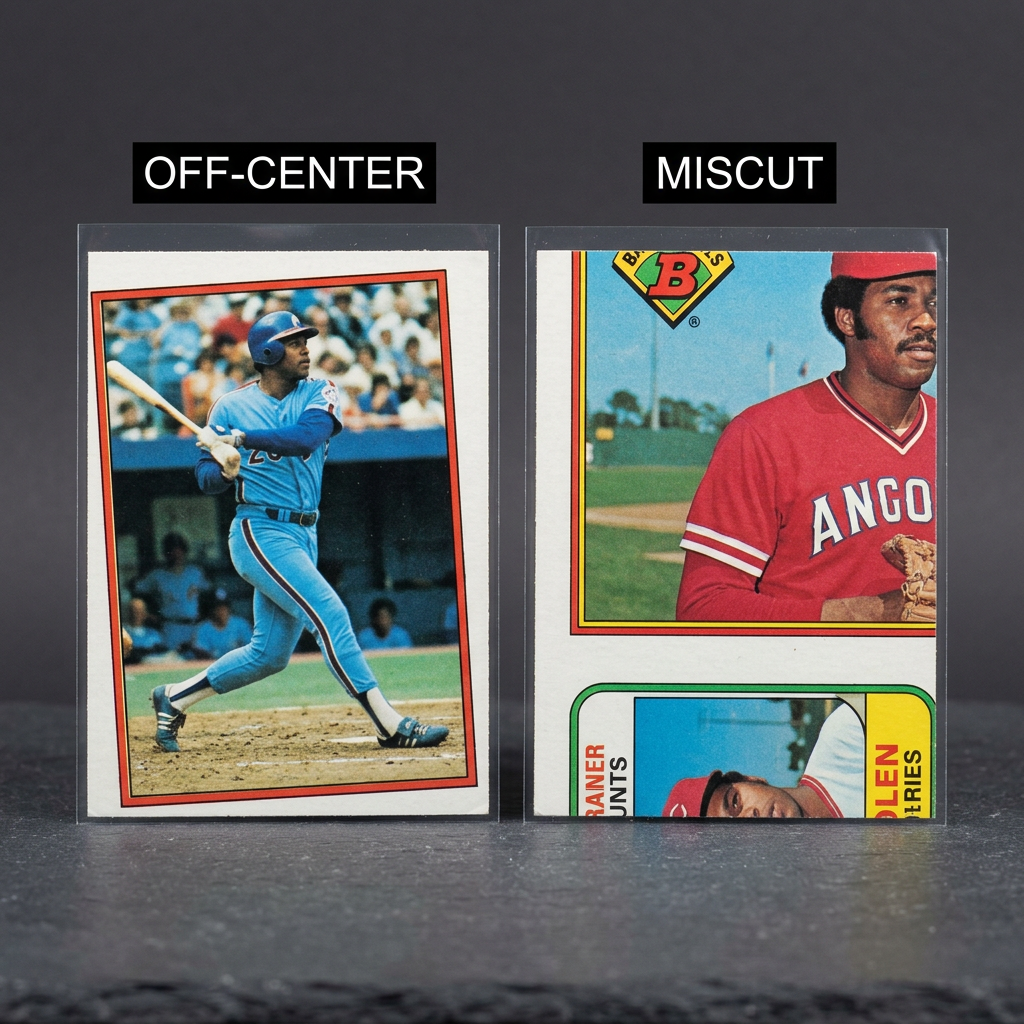
Updated May 2026. Off-center and miscut are not the same thing — but most collectors use the terms interchangeably, and it can cost real money. An off-center 1999 Base Set Charizard might grade PSA 8 and sell for hundreds. A true miscut version of the same card can be worth thousands, precisely because the cut itself is a manufacturing error.
This guide breaks down exactly what separates an off-center card from a miscut card, why grading companies treat them differently, and how to spot a genuine miscut versus a heavily off-center copy before you decide what to do with it.
What is the difference between off-center and miscut?
An off-center card has been cut correctly, but the printed image sits unevenly within those borders — one side has a thicker border than the other. A miscut card has been cut incorrectly during manufacturing, often slicing through the design, revealing parts of neighboring cards, or showing factory alignment marks. Off-center is an image-placement issue; miscut is a factory-cutting defect.
What does off-center mean?
An off-center card is one where the cut itself is normal — the card is the correct standard size and shape — but the printed image sits unevenly within those borders. The result is one border noticeably thicker than the opposite border.
Common off-center patterns include:
- Thicker left border than right border (horizontal off-center)
- Thicker top border than bottom border (vertical off-center)
- Both axes off (diagonal imbalance)
- Subtle off-center: 55/45 to 60/40 — visible only on inspection
- Heavy off-center: 70/30 or worse — clearly visible at a glance
Off-center cards are common in modern Pokémon (Sword & Shield, Scarlet & Violet eras) and across most sports card brands (Topps, Panini, Bowman). The card is fully gradeable — it just may not earn a Gem Mint result if the centering crosses the threshold for the grade you want. For exact thresholds, see our breakdown of card centering ratios explained.
What is a miscut card?
A miscut card is dramatically more extreme. It is a true manufacturing error where the card was sliced incorrectly off the printing sheet — not just where the image landed, but the physical cut itself was wrong.
Clear visual signs of a miscut include:
- Part of a neighboring card visible along one edge
- Factory alignment dots, registration marks, or print code lettering exposed
- Dramatically uneven borders (think 90/10 or worse)
- The design itself running off one or more edges
- The card cut at a slight diagonal angle
- Visible white margin where the card sheet was over-cut
At that point, the issue is no longer subtle border imbalance — it is a clear factory defect. Miscut cards are often documented and prized as authentic printing errors, which can flip them from a grading negative into a serious collectible asset.
Why the off-center vs miscut difference matters for value
The financial implications of off-center versus miscut are completely opposite:
- Off-center cards trade at a discount — buyers expect a centered card and pay less for cards that fall short
- Miscut cards can trade at a premium — error collectors actively chase authenticated miscuts, especially on iconic cards
- Off-center caps the grade — a 65/35 card almost always grades PSA 8 or lower regardless of other condition
- Miscut can earn an error designation — PSA, BGS, and SGC may slab miscut cards with a special label noting the factory error
- Demand profiles differ — off-center buyers want condition; miscut buyers want the manufacturing story
That is why correctly identifying which category your card falls into matters before you make any submission or sale decision.
Can an off-center card still grade well?
Yes — but only up to a point. Centering is one of four condition factors, and the threshold matters:
- 50/50 to 55/45: Within PSA 10 / BGS 9.5 / SGC 10 tolerance on the front
- 55/45 to 60/40: PSA 9 territory — still a strong, valuable grade
- 60/40 to 65/35: PSA 8 (Near Mint-Mint) — gradeable but with clear discount
- 65/35 to 70/30: PSA 7 (Near Mint) — grade reflects the visible issue
- Worse than 70/30: Lower numerical grade, or potentially miscut territory
A card does not need perfect 50/50 centering to earn a strong grade — but the further you drift from 50/50, the lower the ceiling becomes. That ceiling is precisely what the AI card centering tool is designed to measure before you spend a grading fee.
When does off-center become miscut?
There is no precise universal rule, but visual signals make the call clear:
- Slightly off-center (52/48 to 58/42): Normal manufacturing variance, gradeable at high levels
- Strongly off-center (60/40 to 75/25): Visible imbalance, capped at lower grades
- Borderline miscut (75/25 to 90/10): Image visibly shifted, may or may not show factory marks
- Clear miscut: Part of another card visible, alignment dots exposed, or design running off the edge
The diagnostic question is simple: was the cut wrong, or was the image placement wrong? If you can see another card's content, a registration mark, or a slice through the design itself, it is a miscut. If the card is the correct size and shape but the borders are just uneven, it is off-center.
Are miscut Pokémon and sports cards valuable?
Yes — sometimes significantly so. Authenticated miscut cards have a dedicated collector base that prizes them for the same reason error coins or stamp misprints carry value: they are rare manufacturing artefacts that prove a specific moment in production went wrong.
Notable miscut examples that have sold at major premiums include:
- Miscut 1999 Pokémon Base Set holos with visible alignment marks
- Miscut modern Pokémon chase cards from Brilliant Stars and Crown Zenith
- Topps Chrome and Bowman miscut rookies showing print code lettering
- Vintage Topps baseball miscuts where the card design runs into the next card
Value depends heavily on the dramatic nature of the cut, the desirability of the underlying card, and authentication. A miscut common is still a common — a miscut Charizard is something else entirely.
Should I grade my off-center or miscut card?
The decision is completely different depending on which one you have:
For off-center cards: Submit only if the centering supports the grade required to justify the fee. A 60/40 card capped at PSA 9 may still be worth grading if the raw card is valuable enough. A 70/30 card capped at PSA 7 usually is not worth the cost. Run the math first.
For miscut cards: Submission decisions are about authentication, not condition. Many error collectors specifically want PSA, BGS, or SGC authentication on the miscut itself — not for a high grade, but to verify the error is genuine. The slab and label become the proof.
For the full pre-grading framework, see our guide on should I grade this card. For sports collectors evaluating Topps or Panini miscuts, the sports card centering tool helps confirm whether you have a true miscut or a heavily off-center copy.
How to confirm whether you have a miscut
Before claiming a card is miscut — especially before paying for grading or listing it for sale — verify these signals:
- Compare against a centered example of the same card from PSA Set Registry or eBay sold comps
- Measure the actual card dimensions — a true miscut may be a slightly different size
- Check all four edges for factory print marks, alignment dots, or partial neighboring designs
- Look for diagonal cut angle (a true miscut often isn't perfectly rectangular)
- Compare against known miscut examples documented in collector communities
If none of those signals are present and the card is just heavily off-center, it is off-center, not miscut. Be honest about the category — it matters for valuation and submission strategy.
Frequently asked questions
They can be. True miscuts where another card's edge, alignment dots, or factory markings are visible often sell at a premium because collectors specifically chase printing errors. The more dramatic and clearly miscut, the higher the potential value.
Yes, PSA grades miscut cards and often gives them a special designation noting the error. The card will not earn a high condition grade due to the cut, but the error designation itself can add collector value to certain rare miscuts.
Off-center means the image is unevenly placed within a normally cut card. Miscut means the cutting process itself failed — the entire card was sliced incorrectly, often revealing parts of neighboring cards or factory marks. Miscut is a manufacturing defect, off-center is image placement.
Yes, especially if the card itself is valuable (rare, vintage, or a chase card). It will grade lower than a centered version, but a PSA 8 or PSA 9 of a sought-after card still holds real value. Just expect a discount versus a clean 10.
Look for parts of neighbouring cards visible along an edge, alignment dots or factory markings, dramatic border imbalance (like 90/10), or an obviously shifted cut where the design clearly runs off one side of the card.
Final thoughts: off-center vs miscut in 2026
Not every uneven card is a miscut. Most are simply off-center — a normal manufacturing variance that affects the grade but doesn't change the card's category. True miscuts are factory defects that flip the entire value conversation: from condition discount to authentic error premium.
Learning to tell the two apart is one of the most useful skills in card collecting. It changes which cards you submit, which ones you sell, which ones you hold, and which ones you celebrate as genuine printing errors.
Ready to know exactly where your card sits? Run it through the free AI card centering tool for an objective measurement before you decide what to do with it.